
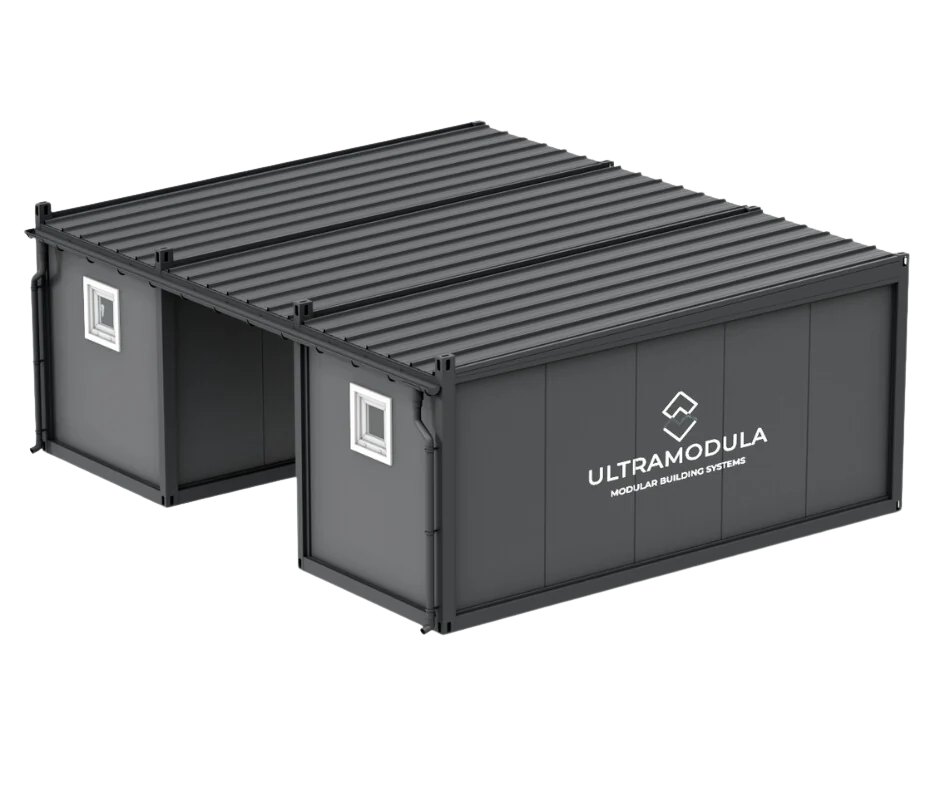

Containers sanitary and office | Ultramodula
Containers and modules represent an innovative approach to construction that significantly accelerates construction processes and offers significant flexibility in the design of commercial and residential spaces. However, the success of such projects depends not only on the high quality of the containers themselves , but also on the proper selection of foundations. This is crucial for the durability and stability of such buildings, which in turn translates into the safety of their occupants and users.
Type of facility and selection of appropriate foundations for container and modular buildings
Each type of container or modular building has its own unique requirements, which must be considered when designing the foundations. Depending on the needs and intended use, the structure of the building, and therefore the foundation structure, will vary slightly. Considering the building type and its specific requirements, structural engineers must develop the design to ensure durability and stability.
Residential container buildings
Modular buildings that serve residential purposes require better thermal and acoustic insulation than, for example, those designed for commercial purposes. This influences the construction of individual modules – thicker walls, different windows and doors, and different interior finishes. Residential buildings are also furnished differently and equipped with different systems, such as plumbing and heating. All these factors influence the type of foundations they should use. Block foundations are a popular solution, especially for temporary homes , as this type of foundation ensures the building is not permanently attached to the ground.
Container offices
Office containers differ from other types of container buildings due to the more demanding nature of office work. Therefore, it's important to properly adapt the foundations to their specific needs. These types of buildings must simultaneously accommodate many people, computers, office furniture , and other equipment (such as air conditioning ), which generates significant point loads on the ground. Therefore, concrete foundations, which can evenly distribute these loads, ensuring stability and uniform load-bearing capacity of the entire structure, are a frequently chosen solution in this case.
Service and commercial facilities
When it comes to commercial or service containers, ensuring the convenience of both customers and suppliers is key. Depending on the specific business and customer requirements, foundations for commercial containers can take various forms. Many businesses opt for post foundations, which allow the container height to be adjusted to the ground level. It's crucial that the building is easily accessible to customers, which is especially important for food stands or kiosks.

Sanitary and office containers | Ultramodula
Factors influencing the selection of appropriate foundations for container and modular buildings
Although erecting a container structure is much easier and faster than a traditional building, it still requires analysis to ensure the stability of the entire structure. The first and crucial step in selecting foundations is a thorough analysis of the ground and geological conditions at the construction site . Different soil types (e.g., sand, clay, gravel) and their bearing capacity can significantly impact the type of foundations needed. If the ground is loose, more advanced foundations may be necessary, while on firm ground, the use of more specialized construction equipment may be necessary. It's worth engaging the services of a geologist to thoroughly investigate these conditions. Careful and accurate soil analysis is crucial to avoiding future problems with building settlement.
Another important factor is taking into account the loads to which the building will be subjected. Foundations must be designed to withstand not only the weight of the building, but also wind and snow loads. In regions where heavy snowfall occurs, it may be necessary to use higher foundations to prevent structures from collapsing during the winter season. In turn, in areas exposed to particularly strong winds, it is necessary to take these impacts into account in the foundation design.
The intended use of a building is also an important variable influencing the choice of foundation type. If the building will be used as a warehouse , the expected structural strength will differ from that required for a residential building. Live loads, such as heavy machinery in a production hall or stored goods, will significantly impact the type of foundation and its load-bearing capacity.
Regardless of all other factors, your budget as well as the availability of materials may limit your foundation choices. This decision has a direct impact on the costs of the entire construction, so it is important to find a balance between technical requirements and available financial resources.
Types of foundations for container and modular buildings
There are many types of foundations, each with its own advantages and disadvantages. It's worth thoroughly exploring the various options available on the market to make the right choice and minimize the risk of potential problems in the future. When choosing a container or modular building from a reputable manufacturer, you have the opportunity to consult with a construction expert, not only regarding the design of the building itself, but also on issues such as foundations and other construction-related aspects.
Block foundation – why is it so popular?
The most common choice of foundations for container and modular buildings are foundation blocks. They have many advantages and are easily available, which is why they are recommended to investors.
One of the key advantages of this solution is the ability to adjust the building level. In the case of container facilities that consist of many modules, precise matching is extremely important. Block foundations allow for precise adjustment of the height of each module, which guarantees even and stable arrangement of the entire structure. Thanks to this, there are no problems with unevenness or curvatures that could affect the durability of the building in the long term.
Block foundations are also extremely practical if there is a need to dismantle and relocate a modular building. This is especially important in situations where plans change and the facility must be moved to another location. Thanks to their design and the ability to balance, block foundations can be relatively easily dismantled and moved, and then reused without significant difficulties.
As we know, the main purpose of foundations is to ensure stability. Block foundations are characterized by a large contact surface with the ground – their wide base distributes the building's weight over a larger surface area, protecting against subsidence and ensuring the structure's durability. This is especially important for modular buildings, such as production halls or offices , which must withstand very heavy daily loads.
When is piling necessary and what are its types?
It is not always possible to use the simplest solutions, such as blocks. In situations where ground conditions are difficult and standard foundations are not durable enough, piling is the recommended option. It is necessary in areas where the ground is too soft to keep traditional foundations in a stable position. Engineers also recommend this solution when the building is exposed to intense dynamic loads, such as wind or seismic shocks. Piling provides additional stability.
Several types of piling can be used in container and modular construction:
- screw-type, which uses anchor bolts screwed into the ground to provide stability;
- baton sticks, which involve driving steel sticks into the ground with an impact hammer;
- hydraulic – this technique uses hydraulic pressure to drive piles into the ground.
A dynamic solution: anchor bolts
Anchor bolts are a less popular but equally effective solution that works great for container and modular buildings. They are particularly suitable for use in areas with soft ground where traditional foundations may fail. Importantly, their installation is relatively quick and simple, and at the same time they are not as invasive as traditional piling. Made of durable materials, anchor bolts are highly resistant to corrosion, which increases their durability.

Sanitary and office containers
The process of designing foundations for container and modular buildings
Designing foundations for container and modular facilities is a process that requires cooperation with an experienced construction engineer, carrying out accurate calculations and structural analyzes and the use of modern digital technologies. This is the only way to ensure that the building will be stable and durable. Before starting the foundation design process, it is worth consulting a structural engineer who will conduct a thorough analysis of local conditions. This will allow you to determine the type and depth of foundations and the possible need to use additional solutions, such as piles or anchor bolts.
The next step is to carry out analyzes and construction calculations. This is to determine what loads will act on the foundations, taking into account both permanent and variable loads. It is also necessary to examine the properties of the soil under the building to determine its load-bearing capacity and geotechnical properties. All this together will allow you to design the appropriate depth and width of the foundations and match the construction materials.
Nowadays, technology plays a key role in foundation design – it's worth utilizing it. Working with specialized 3D analysis and modeling software allows for accurate prediction of foundation behavior under various conditions. These tools allow for the identification of potential problems and optimization of the design, resulting in savings in construction time and costs. Digital technologies also enable the creation of visualizations that facilitate project understanding for all stakeholders, including clients, construction workers, and building inspectors. This, in turn, contributes to increased efficiency in the construction process and minimizes the risk of errors.
Good foundations are essential
Choosing the right foundations is not only a key stage of any construction investment, but also a decision that has far-reaching consequences for the durability, safety and efficiency of the building. It is worth investing time and money in a thorough analysis and consultation with an experienced advisor to optimally select appropriate foundations for container and modular buildings depending on ground conditions, building loads and, of course, budget.