
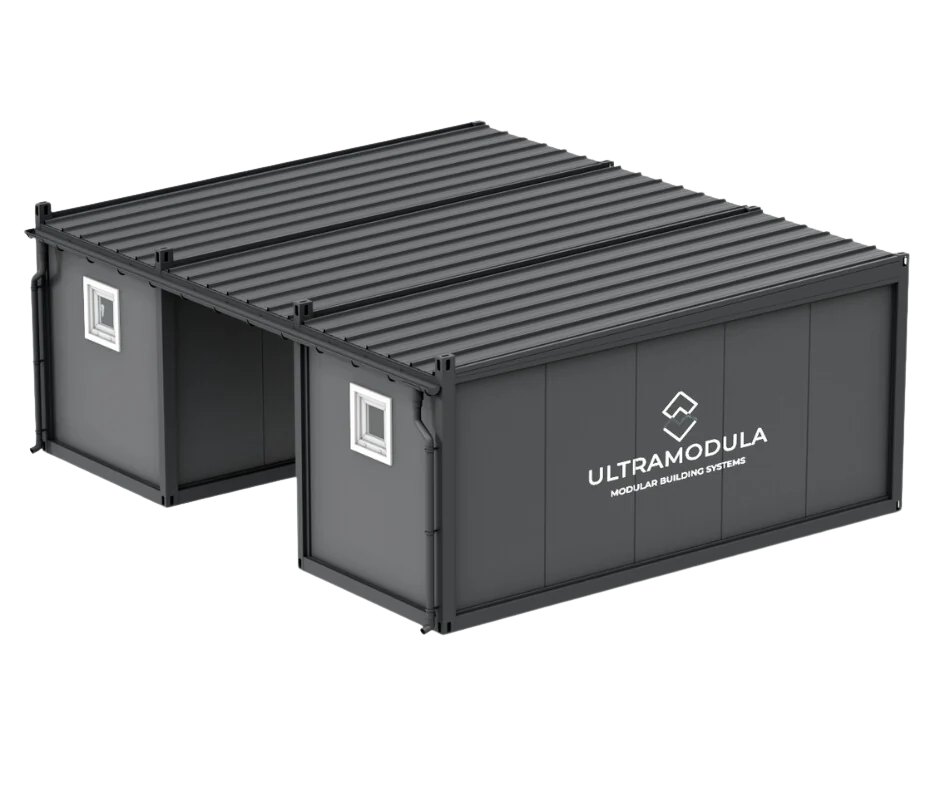

Container cloakroom - implementation Ultramodula
Container locker rooms are no longer a temporary solution – today, they are fully functional, demountable facilities with a low carbon footprint. Well-designed modules combine recycled steel, carefully selected insulation, and modern HVAC systems, making them durable, easy to service, and cost-effective to operate. Below, we present a practical guide to eco-friendly design decisions for investors and architects.
Why a container can be eco-friendly
- Circularity – modules are bolted or welded in a system that allows disassembly, relocation and reuse.
- Prefabrication – quality control in the hall minimizes material losses and energy consumption.
- Compactness of the installation – short routes and integrated systems reduce heat and cold transmission losses.
Recycled materials with a low environmental footprint
Construction and coverings
- Structural and cladding steel – priority for suppliers with a high share of recycled raw materials and EPD declarations.
- Sandwich panels – core selection depending on fire and acoustic requirements:
- Mineral wool (class A1) – ideal for wet areas and those with high fire protection requirements.
- PIR/PUR cores with reduced GWP – very good insulation, used in dry zones.
- Interior finishes – recycled PVC floor coverings, HPL panels, low VOC water-based paints.
- Joinery – recycled steel or aluminum, glass with EPD declaration, stainless steel hinges in wet doors.
Water management and hygiene
- Anti-slip floors with linear drainage made of recycled material (PP/PE).
- Water-saving fittings – time-of-use faucets, showers with flow limiters, dual flush cisterns.
- Easy-to-clean materials – smooth ceilings, hygienic plinths, which reduces the use of chemical agents.
Thermal housing and user comfort
- Insulation thermal – For walls ≤ 0,25 W/m²K, roof ≤ 0,20 W/m²K, floor ≤ 0,30 W/m²K.
- Thermal bridges – spacers in jambs and corners, insulated mounting points for benches and cabinets.
- Acoustics – sound-absorbing panels, flexible underlays in wet areas.

Energy-efficient heating and cooling
Air-to-air heat pumps
They provide rapid heating and cooling, precise zone control, and an automatic "eco" mode. It's worth choosing devices with R32 or R290 refrigerant and a post-workout dehumidification function.
Air-to-water heat pumps
Ideal for properties with extensive shower areas, they require a buffer tank and a domestic hot water tank with circulation and mixing valves to prevent scalding.
Ventilation with heat recovery
Ventilation removes moisture and odors, providing fresh air. High efficiency (80–90%) and CO₂/VOC automation save energy.
Control and automation
BMS light systems with CO₂ and presence sensors, zoning and remote viewing via a web panel optimize energy consumption.
Power and renewable energy sources
- Photovoltaics – mounted on a roof or shed, it compensates for the energy consumption of ventilation and heat pumps.
- Magazine energy – allows you to balance peak loads and provide emergency power.
- LED lighting – with motion and intensity sensors, color 4000 K, IP65 in wet areas.
Designing for longevity
- Anti-corrosion protection – painting for classes C3/C4, galvanizing of elements exposed to splashes.
- Modularity – separate wet zones facilitate servicing.
- Consumption monitoring – energy and water sub-meters, monthly reports for the investor.
Business benefits
- Lower operating costs – reduced energy and water bills.
- Higher comfort and security – no condensation, quick drying after training.
- High residual value – possibility of relocation or resale of modules.
- Meeting environmental criteria – advantage in tenders and public projects.
Sustainable container locker rooms are a new standard in modular construction : recycled materials, a tight and well-insulated enclosure, and intelligent HVAC with heat pumps and heat recovery. This is a durable, economical, and environmentally friendly solution, designed for years of use without compromising comfort.